
Faisalabad district lies in the heart of central Punjab, forming the core of Faisalabad Division and serving as one of the most important industrial regions of Pakistan. Often called the “Manchester of Pakistan”, it is the country’s third-largest city after Karachi and Lahore and anchors a district economy dominated by textiles, agro-industry and trade. The district covers about 5,856 square kilometres and has been structured as a city-district since 2005, reflecting the very close integration between the urban core and its surrounding tehsils.
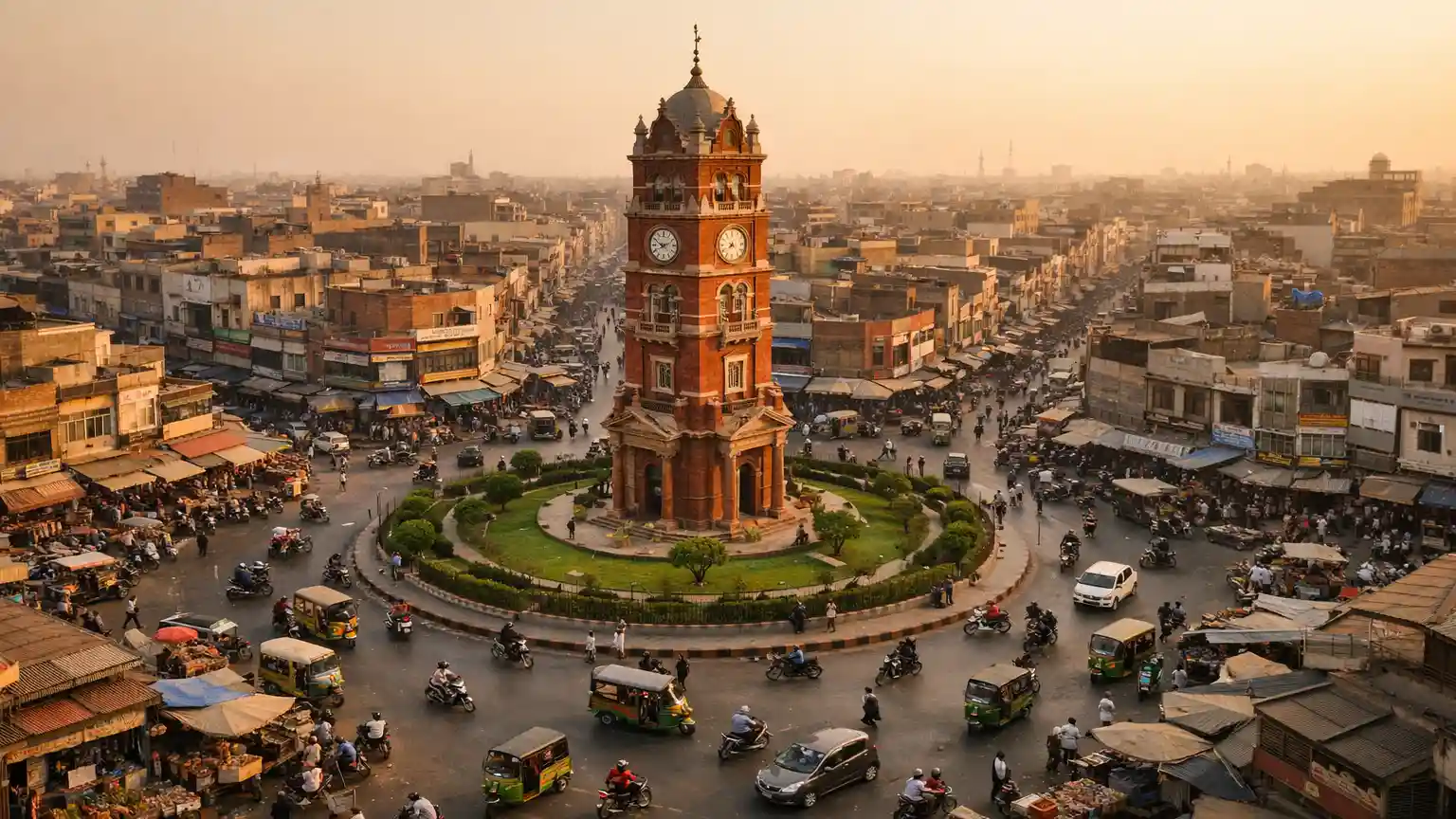
The city’s origins go back to the late nineteenth century when the British developed Lyallpur as the commercial heart of the Lower Chenab Canal Colony. Planned as a market town built around a central clock tower, its eight bazaars were laid out in a pattern inspired by the Union Jack, a design that still defines the historic core today. The canal colony brought irrigated agriculture, migrant settlers and rapid commercial growth. After independence, Lyallpur expanded as an industrial centre and in 1979 it was renamed Faisalabad in honour of King Faisal of Saudi Arabia.
Culturally, Faisalabad is a Punjabi city with strong rural roots and an increasingly urban lifestyle. Traditional bazaars around the clock tower sell cloth, spices and household goods, while new shopping malls, restaurants and housing schemes stretch along Jhang Road, Canal Road and the motorway corridors. The city has tried to cultivate a literary and artistic profile; the Faisalabad Literary Festival, first held in 2014, brought writers and readers together and led to the formation of local writers’ unions and journalist associations that aim to develop a stronger reading culture.
Population and Demographics of Faisalabad
According to the 2023 census, Faisalabad district has around 1.38 million households and a +635235.0population of 9.08 million. Almost 48 percent of residents live in urban areas, making it one of Punjab’s most urbanised districts outside the Lahore region. The overall literacy rate is about 73.4 percent, with male literacy around 77.3 percent and female literacy about 69.1 percent. Punjabi is overwhelmingly the main mother tongue (over 94 percent), followed by Urdu and small pockets of Pashto speakers.
Administration and Tehsils of Faisalabad
Administratively the district is divided into six tehsils: Chak Jhumra, Faisalabad City, Faisalabad Sadar, Jaranwala, Samundri and Tandlianwala. These range from dense urban centres to irrigation-based agricultural landscapes. The city tehsil alone now has nearly 3.7 million people, giving it a very high population density, while the southern tehsils of Samundri and Tandlianwala retain a more mixed agro-industrial character. Faisalabad District has been sub divided into 346 union councils.
Economy and Rapid Industrialization
Economically, Faisalabad is Pakistan’s leading textile district. The city and its surrounding industrial estates host more than 500 textile units producing yarn, greige and finished fabrics, garments, towels, knitwear and home textiles for both domestic and export markets. Some estimates suggest that industry in Faisalabad contributes over one-fifth of Pakistan’s annual GDP or large-scale industrial output, underlining its status as a national manufacturing backbone. The district’s textile complex is complemented by chemicals, food processing, engineering goods and a large wholesale cloth market that feeds into national and international supply chains.
Agriculture remains important outside the dense urban core. Irrigation from the lower Chenab River canal system supports cotton, wheat, sugarcane, rice, fodder and a variety of fruits and vegetables. These crops, in turn, supply raw material to the local textile, sugar and food-processing industries, binding rural hinterlands and urban factories into a single production system.
Rapid industrialisation and urban growth, however, have created serious environmental and planning challenges. Studies and media reports highlight deteriorating air quality, untreated industrial effluents, solid-waste mismanagement and the encroachment of built-up areas onto fertile agricultural land.
Faisalabad is one of the Punjab cities most affected by seasonal winter smog, alongside Lahore and Gujranwala, with traffic, crop-burning and factory emissions contributing to respiratory and cardiovascular illnesses. These pressures have prompted debates about stricter environmental regulation, cleaner production technologies and greener urban planning, but implementation remains uneven.
Education
Faisalabad is also a major educational and research hub for central Punjab. The University of Agriculture, Faisalabad is Pakistan’s oldest and largest agricultural university, founded in 1906 and now ranked among the country’s top institutions in agriculture and veterinary sciences. It trains agronomists, veterinary scientists, food technologists and social scientists who work across the region.
Alongside it, Government College University Faisalabad has evolved from a colonial-era college into a comprehensive public university offering degrees in law, engineering, management, social sciences and natural sciences. Women’s higher education has expanded through institutions such as Government College Women University Faisalabad, reflecting the district’s gradual social transformation.